
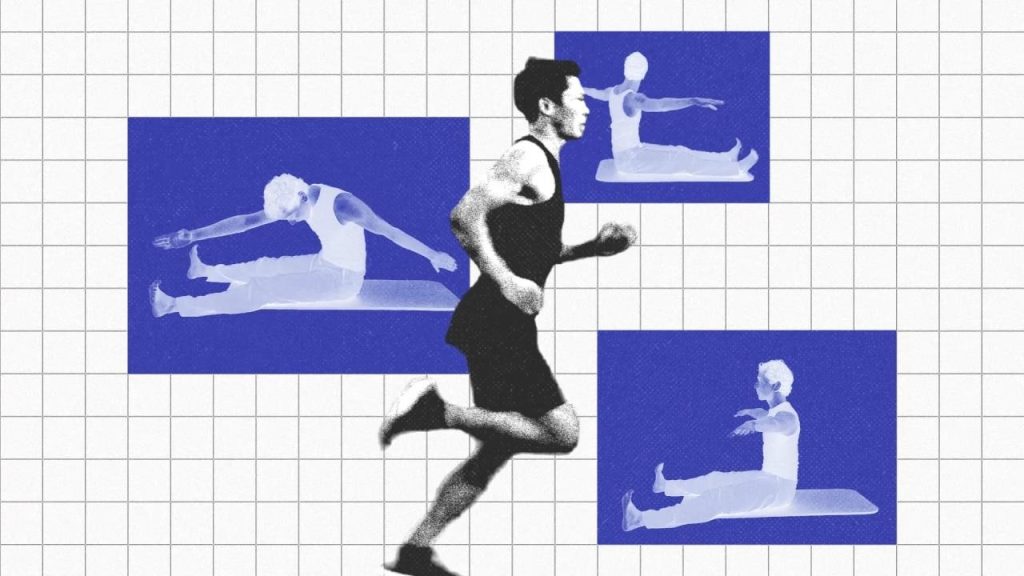
Trading weighted squats in for a pilates mat is a killer way to upgrade your running technique and minimise injury. Don’t believe us? We went and asked the pros for you.
No matter how little or long you’ve been in the running game, you’ll know that there is a lot more to it than just… running. Hunting down the comfiest pair of Asics and meal prepping around your training are important side hustles but what actually keeps your legs turning when it matters most on race day? Strength drills, mobility exercises and yes, pilates.
Implementing this German-born discipline into your weekly running routine—especially if you’re embarking on a marathon—is one of the most effective ways of improving your stride. It deepens your stability, hip control and core strength to name just a few things, so that when you’re about to hit the wall at 42 kilometres, it’s not a Whatsapp from your Mum that brings you home, it’s your form and technique that really make the difference. Hard truth here, pilates is a certified way to build all the foundations you’re probably lacking.
To suss out why pilates has gained such momentum in the running world, we’ve called in some trusty experts to impart some wisdom, including Bryony Deery who has designed an entire pilates platform around this very thing.
What is pilates?
Pilates is an ever-growing practice that has branched into multiple variations (classical, reformer and so on). However, at its core, pilates is characterised by low-impact, highly controlled sequences of movement that work your core stability, posture and body awareness. Pilates instructor and business owner Sam Deville expands: “Pilates is a strength-based training method focused on control, alignment and precision. At its best, it builds deep, functional strength through the core, hips and back, while improving how your body moves as a whole—not just how individual muscles work.”
Even heading on some easy miles can put a lot of strain on your body. Deery explains that “running is a repetitive, high-impact, single-leg sport with over thousands of strides, small weaknesses and imbalances get amplified into injuries or inefficiency. Pilates works on what running neglects: deep core stability, hip and glute control, spinal mobility and posture.”
Both mat and reformer are effective. Deville believes that the fundamentals that come from mat work are “more than enough to build strength and control” when done properly. Physiotherapist at Complete Pilates Helen O’Learly lauds reformer as “it involves more standing exercises, especially single leg exercises that are functionally relevant for runners.”
Why is pilates good for running?
If you’re fed up with paying your running dues in ice baths and magnesium supps, pilates is an easy pay-up-front fix. It assists in building each necessary component for better technique. Plus, it can help you get pretty ripped, which you’ll be grateful for when your marathon snaps come through. So how exactly is pilates good for running? Let’s break down the benefits.
We all know strength training is non-negotiable in the running world, and pilates first and foremost functions as a low impact strength medium that you can perform on your rest days. While traditional muscle-building exercises focus predominantly on training load and larger muscle groups, pilates is more about supporting the body as a whole. “It targets the smaller stabilising muscles, improves joint control, and builds strength in a way that directly carries over into movement,” says Deville. “It’s not just about being stronger but about moving better.”
Take core work, for example. “A strong deep core stops wasted energy and protects your lower back from the impact of running. It stabilises your spine and pelvis every time your foot hits the ground,” says Deery. “When your core is stable, more of every stride goes into forward momentum rather than side-to-side instability. You can [then] feel when your form is drifting on a long run and correct it in real time.”
As a society, our postures are significantly worse than past generations—but attempting to correct your notre-dame posture whilst you’re running will only lead to injury. You therefore need to build this naturally outside of your runs. “Pilates improves awareness and control of alignment—particularly through the spine, pelvis and ribcage,” says Deville. “For runners, that translates into a more upright, efficient posture and better control through each stride, especially as fatigue sets in.”
Downward-dogging your way to a PB is also a great way to introduce variation and balance into your stride, which improves efficiency. “Running is essentially a series of controlled single-leg landings, so the single-leg work in Pilates translates almost directly to better control, fewer ankle rolls and stronger push-off,” says Deery.
Last, but certainly not least, there’s the mindfulness aspect of pilates, and god knows pacing the miles requires an iron-willed mentality. O’Leary says that breath work encourages a “mindful connection to your body, which reduces psychological stress”. Pilates teaches lateral 360 (thoracic) breathing which Deery explains; “expands the ribcage sideways and backwards rather than just lifting the shoulders. This recruits the diaphragm properly and keeps the deep core engaged at the same time; two things runners tend to lose when they get tired.”
How often should I do pilates?
Our three experts advise that 2-3 sessions a week is optimal. Whether you choose to practice pilates on rest days, or alongside a run, the primary intel is that sessions don’t need to be long to be effective—even 15 minutes a day is enough to reap the benefits. If you do opt to do pilates on your mileage days, then make sure you settle for a softer intensity.
“Gentle mat work the day after a long run helps flush the legs, release tight hip flexors and hamstrings, and mobilise a stiff lower back without adding more load. The breathwork and slower-paced classes also down-regulate the nervous system, which is where real recovery happens,” says Deery. “A short 10–15 minute restorative session on a rest day can genuinely shift how you feel going into your next run.”
The beauty of pilates is that, with practice, you become attuned to your body so you’ll learn to work to your energy levels. Anyhow, just make sure you put in time to roll out your mat.
Common weaknesses in runners and how pilates can fix them
Fed up of niggles and stagnancy? For all the good that comes with running, it sure can take its toll. Pilates targets a lot of imbalances in the body and more crucially, can help them from snowballing into something more serious.
“Most running injuries come from poor control rather than lack of effort,” says Deville. “Pilates strengthens the areas that tend to be weak or under-recruited—particularly the hips, glutes and deep core, which reduces unnecessary strain on joints like the knees and lower back. It also strengthens the stabilisers, meaning joints are better supported and less likely to sustain injuries.”
Stress fractures
Most common to endurance runners, stress fractures are caused by repetitive strain and load placed upon bones. O’Leary outlines that “increasing training mileage too quickly, not getting enough sleep or recovery, increased psychological stress” can make you more susceptible to one. The breathwork element of pilates can not only help reduce the latter but is also, according to O’Leary, “a brilliant way to add non weight-bearing exercise to your routine, to maintain strength throughout the rest of the body, and prevent deconditioning.”
Runner’s knee
An injury so rife amongst runners it has earned its own name, runner’s knee can affect one of two areas: “Either the anterior knee pain which affects the kneecap region, or lateral knee pain which can affect the outside of your knee,” says O’Leary. “They can occur due to poor biomechanics or imbalances between muscle groups around the hip, knee and ankle.” Pilates directly works on the alignment between the three by strengthening the stabilising muscles.
Achilles tendinitis
Most common in men over the age of 40, Achilles tendinitis is typically caused by overtraining, or increasing training intensity too quickly, O’Leary says. “It relates to pain in the Achilles tendon which is the soft tissue just above the back of your heel. The pain sometimes comes on at the beginning of a run and then gets better as you warm up. However, if the problem progresses you may start to get pain that doesn’t ease off.”
O’Leary points to a recent study in which a group of runners performed hip and core strengthening over a 6-month period: “They found a 52 per cent reduction in overuse injuries compared to those in a control group who just did static stretches. Pilates is great for working on the strength of these areas.”
Adapting pilates to a particular race distance
Different distances stress the body in different ways, Deery explains, so here is how she advises tweaking your routine:
5K — where focus is on power and posture under speed, she recommends: “Sharper, more dynamic work, single-leg bridges, glute activation, strong thoracic extension helps you hold upright form.”
10k — where focus is on strength and endurance, she suggests: “Deep core stamina, hip stability and controlled mobility so form doesn’t break down in the second half.”
Half or full marathon — where focus is on mobility, resilience and recovery, she points to: “Longer holds, hip-opening work, spinal articulation and restorative sessions because you’re managing cumulative fatigue over weeks of training, not just one hard effort.”
Best pilates exercises for runners
The pilates repertoire is vast, so if you want a workout that actually goes the distance—the following will get you there in no time. We’ve cherry-picked a combination our experts’ go-tos to arrive at the top exercises you need to get down with.
Deville’s faves:
- Single-leg T-Tilt builds balance, glute strength and control through the hips.
- Supine core work strengthens your deep abdominal and pelvic floor muscles allows the whole body to transfer load more efficiently.
O’Leary’s faves:
- The Scooter for endurance, pelvic stability and control, which is important for efficient movement and injury prevention.
- Dead bug works with opposite arms and legs which challenges the obliques and your rotational strength which is really important for running.
Deery’s faves:
- Roll up for spinal articulation, flexibility and core work.
Single leg bridge is crucial for glute and hamstring strength, hip stability and pelvic control.